Compare Nvidia RTX 3060, 3070, 3080 and 3090 graphics cards
Today, the new series of Nvidia Gforce RTX graphics cards provide the graphics power of some of the best gaming PCs. Whether you are planning to build your own system or buying it from a manufacturer, you will most likely buy a PC to play with the RTX 30 series graphics card, unless you plan to use one of the company’s graphics cards. Use AMD.
In any case, this article is about comparing Nvidia’s new graphics cards.
At the time of writing, there are five Nvidia Gforce RTX Series 30 GPUs priced from $ 329 to $ 1,499. This constitutes a very wide range of graphics cards. As you can imagine, this series of graphics cards can provide the graphics power of a gaming PC for relatively heavy games with a resolution of 1080p to professional PCs for 4K resolution design and graphics.
You should know that buying a 30x RTX graphics card can be challenging, especially if you want to match the purchased graphics card with all the other components in your device to run different programs and games in the best way.
Currently, the benchmarks for all of these graphics cards are not fully published. However, we can provide all the technical specifications for each graphics card and recommend the ideal uses for each model.
The easiest way to compare Nvidia Gforce RTX 30 Series cards is to compare them all in one big, detailed table. Some of this information came directly from Nvidia. Others come from a variety of retail sources. The table below contains the information that will be most useful to ordinary consumers:
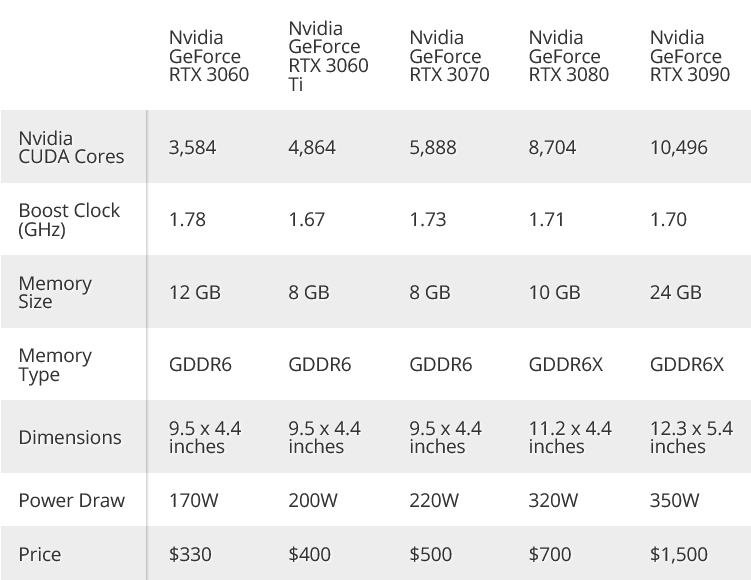
To help you understand some of the terms in the table above, we will define each of these terms.
RTX stands for Ray Tracing Texel eXtreme, a new series of Nvidia graphics cards. This series of Nvidia graphics cards support beam tracking technology. Beam interception can vividly simulate the natural reflection of light on objects, which if computer games use this technology, the shadows created in the game will be very natural.
Nvidia Koda cores refer to the parallel data processing units within the graphics card. They work like a CPU on your computer. In general, the more cores a graphics card has, the more complex the data can be processed quickly.
Clock boost refers to the maximum speed that the graphics card can reach (if it has enough power and cool temperature). Basic clocks are also present in graphics cards, but Nvidia graphics cards boost clock speed while playing, assuming you have a powerful system that does not involve other processing. Higher clock speeds generally mean better performance, but it depends on many factors, including your PC hardware.
Memory type is an important feature in graphics cards. In short, the GDRD 6X has more bandwidth than the GDRR 6 memory and is therefore (theoretically) capable of running heavy games with higher settings.
Finally, power consumption means how much energy it consumes when the graphics card is under a single graphics load alone and running at maximum power. Nvidia also offers recommendations on the amount of power required for G-Force RTX graphics cards installed in a computer, but we have not included this data in the table, as the choice of power supply is entirely up to you.
The good news is that despite all the differences in Nvidia’s new series of graphics cards, the five Nvidia Gforce RTX 30 Series graphics cards being compared here have a lot in common. They all support 2nd generation beam interception. They all use Nvidia amp architecture. They all use Nvidia DLSS (a kind of resolution enhancer with the help of artificial intelligence for games).
Nvidia Free Style, Shodoplay, Highlights, GSink and Koda work on all 30 Series graphics cards. All of them are ready to use virtual reality and compatible with HDMI 2.1. Theoretically, all of them can support 8K resolution. Of course, depending on what you are going to do in 8K resolution, there will undoubtedly be significant differences between 3060 and 3090, but for light work you can also use the 3060 graphics card in 8K resolution.
Finally, if you use four monitors, you should know that all of these graphics cards support four monitors at the same time.
In other words, while there is a significant difference between the processing power of Nvidia 3060, 3060 TI, 3070, 3080 and 3090 graphics cards, they support a set of common core capabilities. Therefore, which one is right for you depends more on the type of user you are and the weight of the different programs and games.
Nvidia Gforce RTX 3090
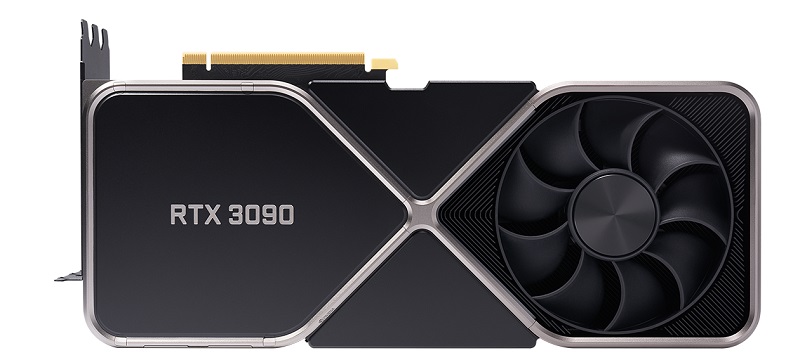
Although it is often easier to find RTX 3090 than cheaper graphics cards, it still costs a lot of $ 1,500 for a graphics card. At this price, you can get a computer with one of the low-end graphics cards and still have enough money for various games and accessories.
In addition, the RTX 3090 is undoubtedly more suitable for users who are looking for professional work, in addition to running more games with the maximum possible graphics. This is a great graphics card and is potentially perfect for the next few years. If you do not want to do graphic work, animation design or professional editing with your computer, buying RTX 3090 will not be suitable for you.
Nvidia Gforce RTX 3080
If you can afford it, the Nvidia Gforce RTX 3080 is generally a good choice for those looking to run PC games with high graphics settings. GDR 6X memory makes lower-end cards perform significantly worse than the Nvidia Gforce RTX 3080.
Of course, this is a very large graphics card and consumes a significant amount of energy, so you need to make sure that your case is large enough for such a graphics card and that your power supply also supports the power required by this graphics card. You will also need a very advanced processor and a lot of RAM to get the most out of this graphics card.
In general, if you have $ 2,000 or more to buy a PC, the RTX 3080 can be an integral part of your system.
Nvidia Gforce RTX 3070
Compared to the 3060TI and 3060 graphics cards, the 3070 is naturally the most powerful graphics card. 3060 has the least power. 3060 TI has medium processing power. The choice between these three graphics cards depends more on the resolution of your monitor.
Nvidia Gforce RTX 3070 is more suitable for users who use a monitor with QH resolution. Of course, those who do not expect computer games to run at more than 30 frames per second can also use this graphics card with 4K monitors.
The graphics card is priced at $ 500 and Nvidia turns the Gforce RTX 3070 into an expensive graphics card. But the significant price difference between this graphics card and RTX 3080 makes many users want to buy this graphics card.
Nvidia Gforce RTX 3060 TI
As shown in the table above, the Nvidia Gforce RTX 3060 TI has 4864 Nvidia Coda cores and 8 GB of GDR 6 memory. This puts the processing power of this graphics card between RTX 3070 (5888 Koda cores, 8 GB GDR 6 memory) and RTX 3060 (3584 Koda cores, 12 GB GDR 6 memory). .
Although the Nvidia RTX 3060 has more RAM, it is generally not as powerful as the 3060 TI. This graphics card seems to be a logical choice for people who want to run various computer games with low-level graphics settings but with QH resolution.
Nvidia Gforce RTX 3060
Nvidia Gforce RTX 3060 is the cheapest RTX 30 series graphics card with relatively high processing power, for users who use 1080p monitors and are looking to run various computer games at a suitable frame rate. It seems like a good choice. Of course, those who use QD resolution monitors may also be able to use this graphics card.
In any case, we do not recommend Nvidia Gforce RTX 3060 to users who use 4K monitors.
The RTX 3060 also has a slight and temporary advantage over the other graphics cards in the series. This minor advantage is that this is the only new Nvidia graphics card that supports Nvidia’s convertible load technology. This technology allows the user to achieve faster frame rates without additional processing power.
But as other 30 Series graphics cards get the technology by the end of the month, the gap between the 3060 and its more expensive models will soon widen again.
For now, it might be wise to choose between 3070, 3060 TI and 3060 based on cost alone. Obviously, the more you pay for a graphics card, the better your system will perform.
What do you think is the best Nvidia RTX 30 Series graphics card? Is it wise to buy RTX 3090 even for professional users? Given that the effects of Corona on chip shortages are declining worldwide? Will we see a reduction in the price of graphics cards in the coming months? Share your views with us in the comments section.
Frequently Asked Questions:
Which RTX Series 30 graphics card is suitable for a 4K resolution monitor?
- RTX 3080 and RTX 3090 graphics cards are suitable for playing computer games with 4K resolution and over 60 frames. Of course, if you do not have a problem with running games with 30 frames, you can get RTX 3070.
Graphics RAM Which RTX Series 30 graphics card is more?
- RTX 3090 with 24 GB of graphics RAM, has the highest amount of graphics RAM among the RTX 30 series graphics cards. The RTX 3060 is in second place with 12GB of graphics RAM. So it is better for users who need a high amount of graphics RAM but can not afford RTX 3090, to buy an RTX 3060 graphics card.
Which RTX Series 30 graphics card is suitable for a 1080p monitor?
- If you want to run computer games at 60 frames per second, the RTX 3060 is a good choice. But if you are looking for firmware 144 and even higher, it is better to buy RTX 3060 TI.
Note that in addition to a powerful graphics card, you also need a powerful CPU to run high-firmware computer games. Even if you buy a 3090 graphics card but your computer’s CPU is weak, various games with high frames will not run. Frameworks of 144, 240 or 300 frames per second put significant pressure on the CPU.


Comments
Post a Comment